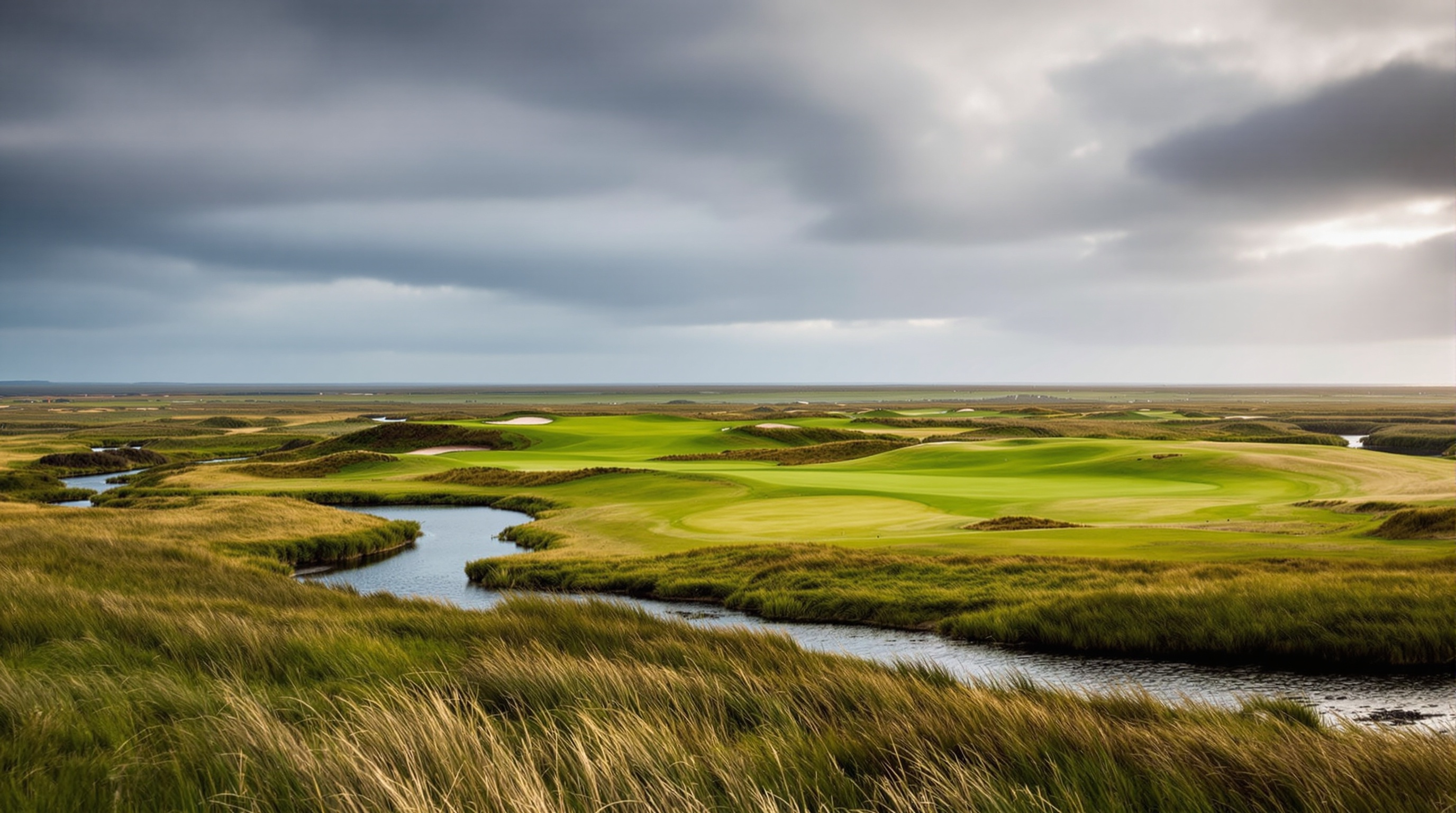
Carnoustie, Angus, Scotland
Carnoustie Golf Links – Championship Course
Relentlessly demanding and magnificently unforgiving, Carnoustie is widely regarded as the hardest Open Championship venue in Scotland — a course that bends to no one.
About the Course
Carnoustie Golf Links – Championship Course
Carnoustie Golf Links has been played in some form since 1842, when the land along the Angus coast was first laid out for golf. The Championship Course as it stands today owes its foundations to Old Tom Morris, who redesigned it in 1867, with further significant revisions by James Braid in 1926. The result is a layout of ferocious difficulty and complete integrity — a course that has never been softened to suit the modern game.
What defines Carnoustie is exposure. The course sits on flat, open linksland with almost no natural shelter from the wind, and the Barry Burn winds through the layout with particular menace in the closing stretch. The final five holes — from the long par-three 16th through the Barry Burn-flanked 18th — constitute one of the most punishing finishes in championship golf. The burn crosses the 18th fairway twice, leaving no room for error when a round is on the line.
Carnoustie has hosted The Open Championship multiple times, earning a reputation as the hardest test on the Open rota. It is a place where great players come unstuck and where those who prevail here are tested in every area of their game. For the travelling golfer, it offers an experience of pure, uncompromising links golf in a setting of complete authenticity.
By the Numbers
Course Statistics
Based on course length, terrain & layout
Handicap index suggested for full enjoyment
The Course
Why It Stands Out
Golf's Hardest Test
Carnoustie has a well-earned reputation as the most demanding course on The Open rota. Exposed to the full force of the Angus wind, with narrow fairways and unforgiving rough, it demands precision from the first hole to the last.
The Barry Burn
The burn winds through the course throughout, but its impact is felt most acutely at the finish. On the 18th, it crosses the fairway twice, narrowing the corridor for the approach and making the closing hole one of the most nerve-testing in the sport.
Open Championship Pedigree
Carnoustie has hosted The Open Championship multiple times and has produced some of the most memorable finishes in the major's history. It remains one of the most respected and feared venues on the championship circuit.
A Pure Links Experience
There is nothing manufactured about Carnoustie. The course sits on genuine, unaltered linksland with natural contours, true wind exposure, and a layout that has evolved over nearly two centuries. It is links golf in its most authentic form.
The Course
Course Views
Extend Your Itinerary
Pair It with Other Great Scottish Links
Carnoustie sits at the heart of one of the world's great golf regions. The east coast of Scotland — from Angus through Fife — brings together courses of extraordinary quality within a compact, driveable area.
Golf Travel
How It Is Included
Carnoustie is most rewarding when played as part of a broader east Scotland programme. Its proximity to St Andrews, Kingsbarns, and the Fife coast means it can anchor a multi-day itinerary that covers the full range of what Scottish links golf offers — from the history and fame of St Andrews to the raw, uncompromising challenge of Carnoustie itself. We arrange tee times, logistics, and the wider course selection to build an itinerary that does justice to the region.
To explore how Carnoustie fits into a wider route, visit our Scotland golf tours page.
Begin Your Journey
Play Carnoustie Golf Links
Speak with our team to arrange tee times at Carnoustie and build a private itinerary across the east coast of Scotland.
Start the Conversation